

September Seasonality: Wake Me Up When September Ends?

As my memory rests
But never forgets what I lost
Wake me up when September ends
September began with an unfriendly 'story' following large-scale protests that resulted in the loss of several lives. Deep condolences, and hopefully the storm settles soon.
Speaking about the chaotic events that occurred on Thursday (28 August) and caused the IHSG to correct by up to -2% and net foreign selling of Rp1.12T on Friday (29 August), this is actually not the first time the IHSG has experienced such events.
Three key conclusions we can draw from these various incidents include:
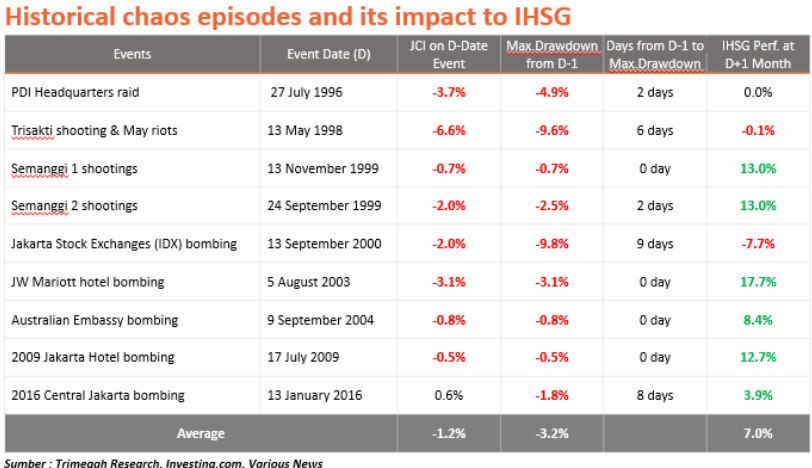
- The largest decline of up to -9.8% occurred during the explosion at the BEI (13 September 2000). However, on average, the maximum drawdown at the IHSG was -3.2%.
- IHSG declines following major events are typically relatively short-lived, and in some cases, the event itself becomes the worst day. In this case, 29 August may be the peak date.
- The IHSG tends to recover with an average increase of +7% per month following the event.
…ber …ber Seasonality
There is no denying that September is often considered the beginning of unfavourable market conditions, including for the IHSG. This is reflected in the IHSG's performance over the last 20 years:
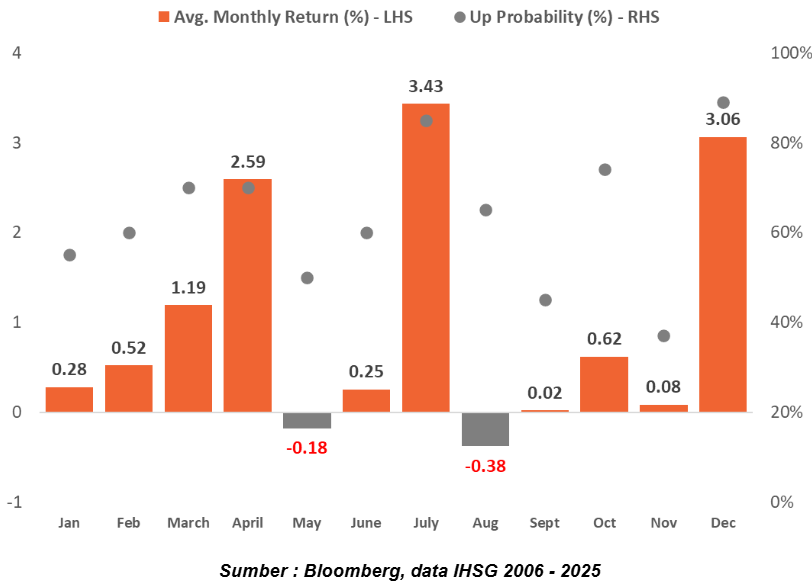
September is recorded as one of the months with less attractive performance (+0.02%) and a probability of increase of only 45%. It's not wrong, but it doesn't feel right if we just "sleep" and "wake up when September ends".
As we wait for the Government to play its part, here are 3 insights we find interesting :
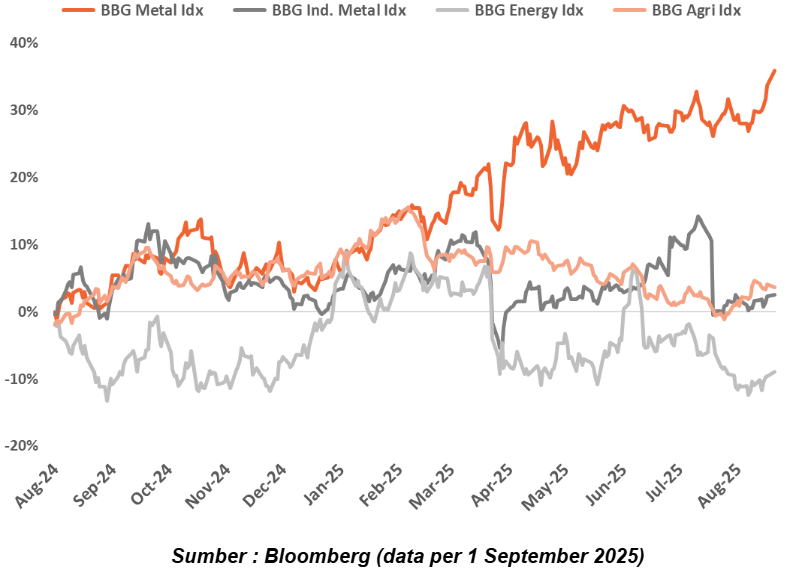
1. The rally in metal commodities continues. This is consistent with the movement of the US dollar index, which tends to be contained (and weakening) as well as strengthening expectations of US interest rate cuts. Investors can take advantage of this opportunity to diversify their assets amid relatively high uncertainty.
2. The probability of US interest rate cuts is increasing. According to data from the CME FedWatchTool (1 September), the probability of a Fed Funds Rate cut has reached 90%, which could be an additional positive catalyst for global and domestic financial markets. It is worth noting that Bank Indonesia cut rates earlier than the Fed by 4 times. This makes stocks that are sensitive (positively) to rate cuts more attractive.
3. Consistent foreign fund inflows to the Indonesian bond market. Calculated from the beginning of 2025 to 29 August, net foreign inflow to Government Securities has reached $4.7bn (equivalent to IDR 77.1T - at an exchange rate of IDR 16.4k), which has successfully offset net foreign outflow from the IHSG of $2.2bn (equivalent to IDR 36.1T).
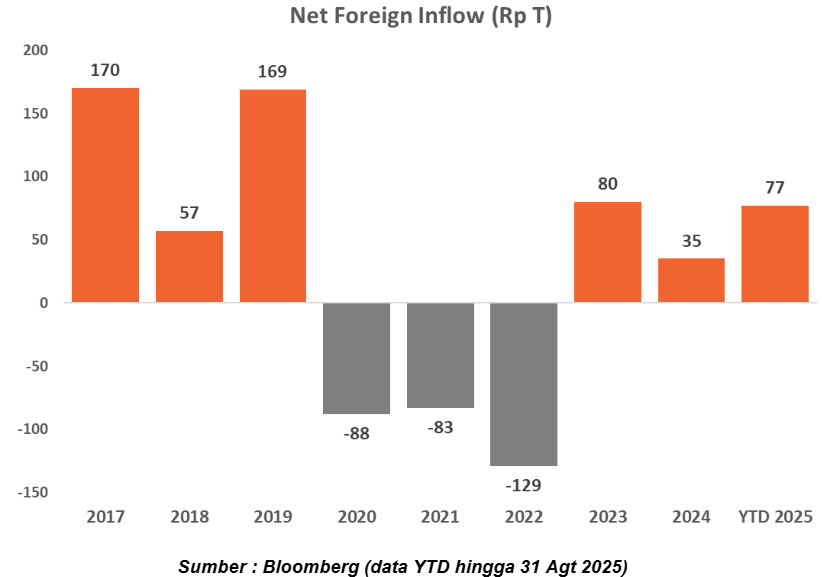
This inflow also partly comes from SRBI liquidity that has flowed back into Government Securities in line with declining yields on the 6M, 9M and 12M tenors, which now range between 5.08% - 5.2% (vs. Government Securities 1Y: 5.4%). Investors can also take advantage of this opportunity to diversify their portfolios into fixed income assets (Government bonds).
Prepare.. Not Predict!
Market timing is indeed not something that investors should easily (or must) do because the probability of error tends to be high (Read Market Insight: Why It's So Difficult to Time the Market). Thus, investors must anticipate certain risks, including: (1) continued domestic political tensions; (2) weakening of the Rupiah exchange rate; (3) revision of company earnings in the third quarter of 2025.
So, let's wake up and stay invested.. WISELY :)
Stay safe, everyone!

Follow Us on:


PT Syailendra Capital is licensed and supervised by the Indonesia Financial Services Authority (OJK)